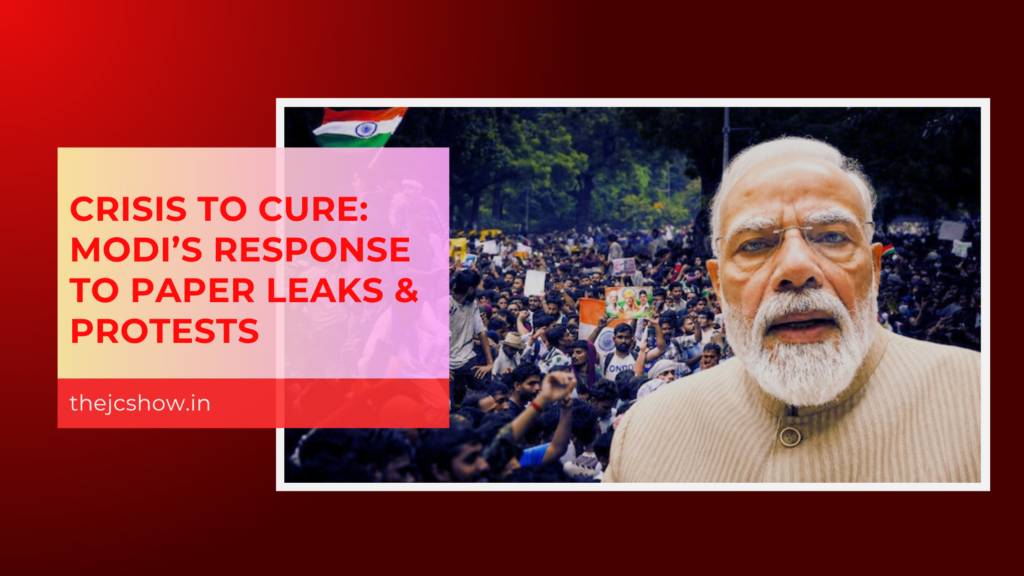
India’s education system has been at the center of a national storm in 2026. From the fallout of the NEET paper leak controversy to nationwide student protests led by the Cockroach Janta Party (CJP), the crisis pushed the government into damage-control mode — and ultimately forced the resignation of Union Education Minister Dharmendra Pradhan.
For weeks, visuals of angry students at Jantar Mantar, hunger strikes, and heated Parliament sessions dominated news cycles. What began as anger over a leaked exam paper snowballed into one of the most closely watched political crises of the year — testing the government’s crisis management machinery and putting the spotlight squarely on Prime Minister Narendra Modi.
In this episode of The JC Show, our panel of political analysts breaks down how PM Modi personally stepped in to manage the crisis, the political fallout of Pradhan’s exit, the role of the judiciary, and what all of this means heading into the 2026 state elections.
🎥 Watch the Full Episode
For the complete panel discussion — including PM Modi’s Instagram following, India’s foreign policy angle with Donald Trump, and more — watch the full episode of The JC Show: Crisis to Cure — Modi Delivers on our YouTube channel.
What Triggered the Student Protests?
The protests trace back to allegations of paper leaks in national-level competitive exams, echoing the 2026 NEET controversy that saw a major medical entrance examination cancelled and re-scheduled following a CBI investigation. Over 2.2 million students had appeared for the exam, and reports of a pre-circulated guess paper matching the actual questions sparked outrage across the country.
This wasn’t an isolated incident — it followed a pattern of exam irregularities that has plagued Indian competitive exams for years, from state-level recruitment tests to national entrance exams. But 2026 was different in scale. Anger over repeated paper leaks, the emotional weight of student suicides linked to exam pressure, and a perceived lack of accountability from testing agencies pushed thousands of Gen-Z students onto the streets.
The Cockroach Janta Party (CJP), founded by Abhijeet Deepke, quickly emerged as the political face of the movement, organizing sustained demonstrations and positioning itself as the voice of a generation frustrated with India’s exam culture. Notably, the panel discusses how many parents actively encouraged their children to join the protests in Delhi — a detail that underscores just how widespread the frustration with the exam system had become, cutting across generational lines.
PM Modi’s 6-Step Action Plan
According to the episode, the government’s response centered on six major steps, all rolled out in quick succession to regain control of the narrative:
- National Exam Reform Task Force — a dedicated body constituted to overhaul how public exams are conducted, monitored, and secured going forward.
- A tougher Anti-Paper Leak Law — enhancing the existing Public Examinations (Prevention of Unfair Means) framework with sharper legal teeth.
- Strict penalties — up to 10 years in prison and fines of ₹10 crore for those found guilty of exam fraud, a significant escalation from earlier provisions.
- Special Task Force and Fast-Track Courts — set up specifically to investigate and prosecute paper leak cases without the delays typical of India’s judicial process.
- AI and digital malpractice accountability — new rules holding exam agencies directly responsible for tech-enabled cheating, an increasingly common method of exam fraud.
- Direct public outreach — including a late-night selfie video from PM Modi that crossed 40 crore views, a moment the panel discusses at length as a case study in the PM’s signature direct-connect communication style.
The panel’s discussion goes beyond simply listing these measures — it examines whether this represents a genuine structural fix to a decades-old problem, or a politically timed response designed to defuse an escalating crisis before it caused lasting damage to the government’s image. The 40-crore-view selfie moment, in particular, is analyzed as part of a broader pattern of Modi using social media to build a direct emotional connection with the public during moments of crisis, bypassing traditional political messaging entirely.
Dharmendra Pradhan’s Resignation: What It Means
Education Minister Dharmendra Pradhan’s resignation became the single biggest flashpoint of the entire crisis. For days leading up to it, government sources reportedly held firm on not accepting his resignation — before an abrupt reversal saw it accepted, catching many observers off guard.
The panel debates whether this marks a genuine acceptance of ministerial accountability or a calculated political move to defuse public anger and give the protest movement a symbolic “win” without conceding any of the substantive demands. There’s also discussion of what comes next for Pradhan politically — drawing comparisons to previous Education Ministers like Smriti Irani, Prakash Javadekar, and Ramesh Pokhriyal Nishank, who also moved on from the portfolio under varying circumstances, and whether his exit signals the government’s first real “back foot” moment in this crisis.
Adding another layer to the story, the episode explores the timeline discrepancy — reports suggest BJP negotiators had floated the idea of simply reshuffling Pradhan’s ministry a day before his resignation, rather than accepting it outright, raising questions about how the final decision was actually made and by whom.
The RSS and Ideological Influence
One of the more intriguing threads the panel explores is the extent to which RSS ideologue Mohan Bhagwat’s views may have influenced the protesting students — and whether his position played any role in the government’s decision to ultimately accept Pradhan’s resignation. This ties into a broader conversation about how the Sangh Parivar’s ideological positioning intersects with day-to-day government crisis management.
Supreme Court’s Role: FIRs, Pellet Guns, and Police Conduct
As the protests intensified, the judiciary stepped in to draw clear lines around how the state could respond. The Supreme Court weighed in on the use of force against demonstrators, issuing directions on the use of pellet guns to disperse crowds and ordering a review of FIRs filed against protesters with criminal backgrounds.
Importantly, the Court also made clear that peaceful, non-criminal protesters should not face police action or lathi charges simply for participating in a demonstration — reinforcing the principle that agitation alone does not justify disproportionate force. The panel discusses the balance the Court is trying to strike: holding genuinely violent or criminal elements accountable, particularly those using obscene or defamatory language during protests, while protecting the constitutional right to peaceful protest for the vast majority of student demonstrators.
The Political Fallout
With Parliament passing the Anti-Paper Leak Bill amid a dramatic opposition walkout, the crisis has left a deep imprint on India’s political landscape. The episode also explores several other angles:
- Bansuri Swaraj’s Parliament speech — the young MP’s articulate defense of the bill during debate drew comparisons to her mother, the late former External Affairs Minister Sushma Swaraj, and is analyzed as a breakout political moment.
- CJP’s political future — whether the protest movement formalizes into a full-fledged political party, and what that could mean for India’s youth-driven politics going forward.
- Cabinet reshuffle speculation — including the appointment of Pralhad Joshi as the new Education Minister, and rumored (but unconfirmed) moves involving Devendra Fadnavis and Eknath Shinde.
- Impact on state elections — with five states headed to the polls in the coming months, the panel weighs whether this crisis will actually move votes or fade from public memory, as past agitations often have.
- Opposition dynamics — questions around Rahul Gandhi and Priyanka Gandhi’s role in the protest narrative, differences within the INDIA bloc over how to handle the movement, and whether the crisis exposed cracks in opposition unity.
- Delhi Police Commissioner’s exit — the sudden departure of Satish Golcha from the post, and what it signals about accountability within the security establishment.
- Parliament logistics — Lok Sabha Speaker Om Birla’s role in resolving a seven-day legislative deadlock caused by the crisis.
Beyond the Crisis: Foreign Policy and Broader Governance
The episode closes with a shift in focus to PM Modi’s broader public image, including the massive following he commands on Instagram, his diplomatic rapport with global leaders — including the much-discussed dynamic with Donald Trump — and how India’s domestic political crises intersect with its foreign policy positioning on the world stage. This ties the episode back to The JC Show’s core focus: understanding how domestic events shape, and are shaped by, India’s standing internationally.
Conclusion
The paper leak crisis of 2026 has turned into far more than an education controversy — it has become a test of the government’s crisis management, a flashpoint for Gen-Z political mobilization, and a preview of how youth-led movements like CJP could reshape India’s political landscape ahead of the upcoming state elections.
PM Modi’s six-step response, from the new Anti-Paper Leak Law to the National Exam Reform Task Force, signals an attempt to draw a firm line under the issue — but whether it addresses the root causes of India’s exam malpractice problem, or simply manages the political fallout, is a question that will likely play out over the coming months. Dharmendra Pradhan’s resignation, the Supreme Court’s intervention on protest conduct, and the political maneuvering around the crisis all point to one thing: this story is far from over, and its ripple effects on India’s education policy and electoral politics are worth watching closely.
You May Also Like

Coffee. Crown. Conversation. Inside The JC Show’s Miss Universe India 2026 Special
September 2, 2026
A New Blue Horizon: Modi’s MAHASAGAR Vision and India-Seychelles Relations
July 29, 2026