When banners reading “Bonjour Modi” went up at Paris’s iconic Salle Pleyel, they captured more than just a warm welcome — they captured a week in which Prime Minister Narendra Modi’s presence dominated global headlines, from the G7 Summit in Evian to a tense handshake with Donald Trump, even as back home India’s political map shifted with a saffron wave in West Bengal. The JC Show breaks down every layer of this story — here’s the complete picture.
What Is “Bonjour Modi”? The Paris Diaspora Event Explained
“Bonjour Modi” was the community programme organised in honour of PM Narendra Modi at Salle Pleyel, Paris, on the final leg of his France visit. Thousands from the Indian diaspora — Tamils, Punjabis, Gujaratis, Marathis and Bengalis alike — gathered to chants of “Modi, Modi” and “Bharat Mata Ki Jai,” with Rajasthan’s Dhoad Band adding a cultural flourish to the evening.
In his address, PM Modi struck a reflective, almost philosophical tone: he said the world is moving toward a partnership model where trust matters as much as trade, and that India is emerging as that trusted partner for the world. He also spoke about 25 crore Indians being lifted out of poverty over the last 12 years, and connected the diaspora’s role directly to India’s growing innovation and trade ties with France.
🎥 Watch the Full Episode
For the complete analysis and the panel, watch the full episode of The JC Show — Bonjour Modi
PM Modi at the G7 Summit: India’s Outsized Presence Without a Seat at the Table
One of the most talked-about threads this week is a simple but pointed question: how does India — not a permanent G7 member — end up commanding centre stage at the summit anyway? At the G7 in Evian, PM Modi engaged directly with world leaders on AI governance, the Global South, and rebuilding international trust, reinforcing India’s position as an indispensable voice in conversations the G7 itself cannot resolve without it.
This is also where PM Modi met Ukrainian President Volodymyr Zelensky on the sidelines, and where his now widely-quoted line landed: the world suffers from a shortage of trust, and that trust in international law must be rebuilt.
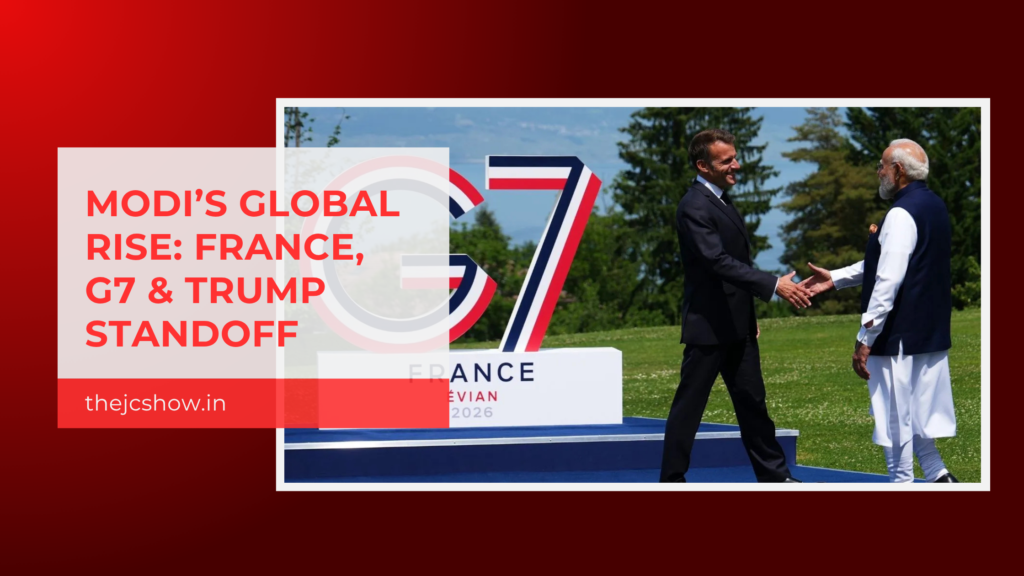
Macron’s Unusual Welcome and the India-France Strategic Roadmap
French President Emmanuel Macron’s reception of PM Modi went beyond standard diplomatic protocol — a detail that’s fuelled plenty of conversation about what it is in Modi’s global standing that prompts world leaders to step outside convention for him.
Behind the optics, the substance was just as significant:
India-France Innovation Roadmap 2030
The two countries formalised an Innovation Roadmap 2030, deepening what is now described as a Special Global Strategic Partnership spanning defence, technology, space, and nuclear energy.
The Jaitapur Nuclear Power Plant Project
Talks around the Jaitapur Nuclear Power Plant resurfaced as a cornerstone of India-France energy cooperation — a project that has long symbolised the depth of bilateral trust between the two nations on critical infrastructure.
UPI Goes Live at the Eiffel Tower
In a moment that’s already gone viral, India’s UPI payment system went live at the Eiffel Tower, marking yet another milestone in India’s digital diplomacy and soft-power expansion across Europe.
PM Modi also offered a striking redefinition of a familiar term, telling the gathering that “AI means All Inclusive” — a line meant to reframe artificial intelligence away from pure technology talk and toward equitable global access.
Slovakia Leg: A Civilisational Welcome and a Top Honour
Before Paris, PM Modi’s European leg included Slovakia, where he was welcomed with the traditional salt-and-bread (namak-roti) ceremony and conferred the country’s highest civilian honour — the 33rd international honour of his tenure. Bilateral agreements signed during this leg are expected to widen trade and people-to-people ties between the two countries.
Modi-Trump Meeting: “A Handshake, Not a Hug”
Perhaps the most-searched storyline of the week: PM Modi and US President Donald Trump met for the first time in 16 months, and the optics were impossible to ignore. One international headline summed it up bluntly — a handshake, not a hug — sparking widespread debate over what’s changed in the Trump-Modi equation, and why Trump’s public and personal posture toward India’s PM seems to have shifted.
The G7 stage added more fuel: Trump’s blunt declaration of “I am the BOSS,” his comments seen as sowing discord within NATO, his public friction with Italian PM Giorgia Meloni, and his claim that any attack on India during Modi’s tenure would see America stand with India — an announcement many political observers flagged as unusually out of turn and out of context for a multilateral summit.
Hormuz Strait Crisis and the US-Iran Deal: What’s Really at Stake
Running parallel to the diplomacy is a tense security and energy story: the Strait of Hormuz crisis. Despite an announced US-Iran peace framework, Iran has repeatedly shut the strait to shipping following Israeli strikes in Lebanon, raising urgent questions about:
- Whether a toll tax on ships transiting Hormuz will be implemented
- The real future of the US-Iran deal and the so-called Islamabad memorandum
- Whether Israel-Hezbollah ceasefire terms can hold under continued strikes
- Who ultimately bears the cost of any extended US-Iran conflict — with concerns that Global South nations may be left to absorb the economic fallout
This is also where pending India-US trade deal talks and the EU-UK free trade agreements come into the picture, as global supply chains recalibrate around the uncertainty.
Back Home: West Bengal’s Saffron Wave and Maharashtra’s Political Storm
While the world watched Paris and Evian, India’s domestic political map was being redrawn:
West Bengal: PM Modi’s first visit to Kolkata after the BJP’s state win drew an overwhelming public response, with Modi declaring that “West Bengal is turning the page after decades of misrule.” His remarks also revisited the historical attempt to make Bengal part of Pakistan, reigniting a charged conversation about the state’s identity and political future — including renewed questions over Mamata Banerjee’s political road ahead.
Maharashtra: A separate political storm has been brewing, with a sharp war of words between Sanjay Raut and Eknath Shinde, reports of Uddhav Sena MPs defecting toward Shinde, and fresh turbulence in the TMC-Shiv Sena equation that has put Lok Sabha Speaker Om Birla’s role under the spotlight.
Why This Week Matters?
Taken together, this week is a study in contrasts: India asserting outsized global influence at forums it doesn’t formally sit on, a US relationship that’s visibly recalibrating in real time, a security crisis in the Gulf with no clean resolution in sight, and a domestic political landscape shifting fast in both West Bengal and Maharashtra. The JC Show brings you the full, no-holds-barred breakdown of every one of these threads — because understanding one without the others means missing the bigger picture.
Conclusion: India at the Centre of a Changing World
From the warmth of “Bonjour Modi” in Paris to the high-stakes conversations at the G7, PM Narendra Modi’s latest diplomatic journey reflects a broader shift in India’s place on the global stage. Whether it was strengthening strategic ties with France, engaging with world leaders, navigating the evolving US relationship, or speaking for the concerns of the Global South, India’s voice continues to carry growing weight in international affairs.
At the same time, the Modi-Trump equation, the uncertainty surrounding global conflicts and energy security, and the rapidly changing political dynamics within India demonstrate how closely domestic politics and global diplomacy are now intertwined. The developments in West Bengal and Maharashtra add another layer to a week that has been anything but ordinary.
The bigger question is not simply what happened this week, but what these developments signal for India’s future. Is India entering a new phase of global influence? How will its relationships with the US, France, Europe and the Global South evolve? And what will these international shifts mean for India’s domestic political landscape?
These are the questions that The JC Show continues to explore — connecting the headlines, examining the power dynamics, and going beyond the surface to understand the bigger picture shaping India and the world.
You May Also Like
Coffee. Crown. Conversation. Inside The JC Show’s Miss Universe India 2026 Special
September 2, 2026
Crisis to Cure: Modi Delivers — Inside PM Modi’s Response to the Paper Leak Crisis and Student Protests
August 1, 2026